How to protect your vehicle from martens if you park in one place for a long time

If you do not use your car for a long time, the condition of the battery or the tire pressure will probably come to mind. However, protection against rodents and martens can easily slip off the to-do list. Yet it is also worth preparing the engine compartment of a second car that is used only rarely, a vehicle parked for a longer trip, or a motorhome put away for the winter for unwanted visitors.
Prevention does not mean you have to inspect your car every day like a mechanic. A few conscious preparations, occasional checks, and protection suited to your parking habits can together help reduce the chance that your next drive starts with a service visit.
A switched-off engine does not mean the danger is over
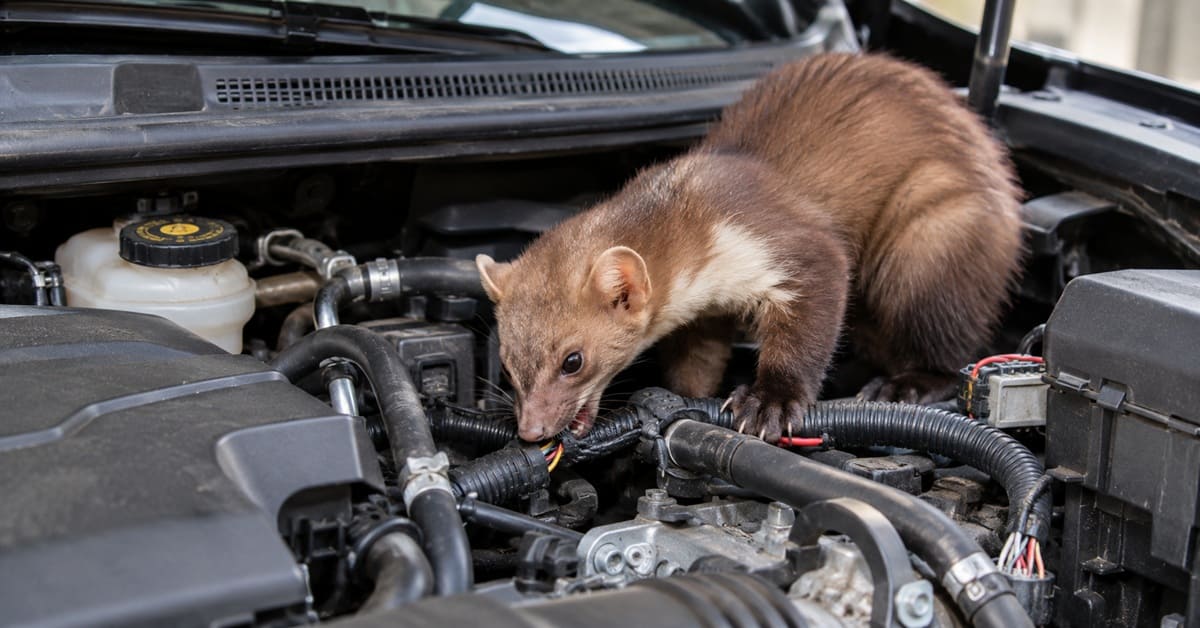
It is easy to think that martens are attracted only by the heat of the engine, so a car that has been standing for days and is completely cooled down is no longer interesting to them. However, the engine compartment is still a sheltered, segmented hiding place even when it is cold, which animals may inspect and where they may leave traces.
For mice and rats, an environment that is rarely disturbed can be especially favorable for settling in. They may carry in leaves, scraps of paper, food, and damage insulating materials. In the case of martens, other behavior also plays a role: scent markings left in the engine compartment and the presence of another marten may also be linked to the damage.
One important drawback of longer parking is that you notice changes later. During daily use, an unusual smell, a new trace, or a warning light may stand out. In a car that has been standing for weeks, these are more likely to go unnoticed.
First, check the area around the parking spot
Before you rush to buy a car marten repellent, it is worth taking a few steps you can do for free. If you are parking the car for a longer period, take a look around where it will be standing. Is there opened pet food, birdseed, accessible trash, or piled-up clutter nearby? Clearing these away is a simple but important part of prevention.
Keep food in a lockable, chew-resistant container, and preferably not directly next to the car. Animals can hide among cardboard boxes, rags, and seldom-moved items piled up in the garage, so a more orderly environment also makes inspection easier. As we always emphasize, rodent repellent starts with tidying up.
Also remove food scraps, packaging, and treats left in the car for pets from the passenger compartment. Cleaning alone does not make the car animal-proof, but we should not offer easily accessible food in the immediate vicinity of the parking spot.
Take a few photos of the engine compartment
Before a longer period of inactivity, with the engine cold, look under the hood. Check for unusual debris, gathered plant matter, droppings, damaged insulation, or chew marks. If you already find suspicious damage at this stage, do not postpone checking it until the next day you use the car.
It can also be useful to take a few well-lit photos. It is easier to compare with a photo showing an earlier state than to try to decide from memory whether that pile of leaves or damaged piece of foam was already there. You do not need to know every component to notice newly appeared changes.
If an animal has already been in the engine compartment before, in addition to checking for damage, it may also be necessary to professionally remove dirt and scent traces. Because of the sensitive electrical components, it is worth consulting a specialist about how to clean the engine compartment. Removing odors is important because martens, for example, clearly perceive it as an intrusion if you park with scent marks left by a previous marten in another marten’s territory.
A closed garage does not replace inspection
A garage can help a lot in protecting the car, but it only becomes a real barrier to animals if they cannot get in easily. Check the bottom of the door, the area around the doors, and where cables pass through. Of course, the necessary ventilation should be maintained while eliminating possible entry points.
Do not consider running the engine for a few minutes as marten or rodent protection. The technical tasks related to longer-term car storage should be carried out according to the manufacturer’s instructions, and animal protection should be handled separately.
You need protection that is suited to the car’s idle time
A regularly used car and a vehicle parked for weeks present different situations. It matters whether the car battery is accessible, whether there is an outlet in the garage, and when there will be an opportunity to recharge the alarm.
When developing the Vadalarm AutoGuard, we also considered these different usage situations. To our knowledge, there is no other car marten repellent on the European market that changes its behavior depending on whether it is used connected to the car battery or on its own. In addition, the Vadalarm AutoGuard also assigns a separate mode to USB-C external power supply.
In practice, this means three operating modes. The device adjusts the alarm and charging according to the type of power supply, so it can be used with different parking and car-use habits as well.
1. Standalone mode: if you do not want to connect it to the car
You charge the AutoGuard via USB-C, secure it safely in the engine compartment, then disconnect the charging cable and switch it on. In this mode, it runs on its own battery and alerts with ultrasound and light signals every 5 seconds.
With a single charge, it can operate for up to 3 months, which makes this mode practical for cars parked for longer periods as well. However, the "up to" is important: the actual runtime is also affected by conditions such as temperature. Before a longer period of inactivity, charge it fully, and do not skip periodic battery checks.
Standalone operation is also convenient when the car battery is in the trunk or in another hard-to-reach place. You do not need to route cables throughout the car just to use the marten repellent. The electrical connection can be left out, but stable and proper placement is still necessary in this case as well.
2. Car turbo mode: automatic charging and a stronger alarm
If you connect the AutoGuard to the car’s 12 V battery, it automatically switches to car turbo mode. When the vehicle’s charging system is operating, the device charges its own built-in battery.
As soon as vehicle-side charging stops, the AutoGuard’s power intake also stops. After three minutes, it activates the alarm at extra strength, which it runs from its own battery. So while parked, it does not drain the car battery.
In this mode, the operating time available for the alarm is one month. For longer periods of inactivity, it is therefore important to plan ahead: connecting it to the car does not by itself mean unlimited power supply, since when stationary the device does not replenish the energy used from the car battery.
When the vehicle’s charging system starts working again, the AutoGuard turns off the alarm and begins charging its own battery again. You do not need to switch it on and off manually every time you start and stop. The operation is based on detecting vehicle-side charging.
3. Mains turbo mode: if there is an outlet in the garage
If the AutoGuard receives power from a mains adapter via USB-C, it automatically switches to mains turbo mode. In this mode, it alerts more intensively: every 3 seconds it emits an ultrasonic signal for 1 second, while the white LED flashes rapidly.
Its power consumption in this mode is also less than 0.5 W. So in a garage with mains power available, you do not have to rely solely on the energy stored in the built-in battery during longer periods of parking.
With two devices, you can set up an alarm both in the engine compartment and in the garage: one can operate installed in the car, and the other can be placed in the room. However, the placement of the device put in the garage matters just as much as the one in the engine compartment. Shelves, boxes, and car parts can shield the signals, so the alarm used in the garage should not be seen as an automatic replacement for the device in the engine compartment.
If you power the device placed in the car with an external cable, always disconnect and remove the mains cord before driving off.
Plan the runtime before longer parking as well
The AutoGuard’s three operating modes have different advantages. When used on its own, long battery runtime takes priority; when connected to the car, automatic charging and extra-strong alarm are the focus; and when powered from the mains, continuous external power supply comes to the fore.
If you leave the car on its own for several weeks, before setting off think through which mode the device will remain in, how long it needs to supply power, and who will be able to check it. Do not confuse the three-month standalone runtime with the one-month operating time of car turbo mode.
Along with the alarm, an orderly parking spot, checking for traces, and repairing any damage remain important. The Vadalarm AutoGuard car marten and rodent repellent is designed to alert against animals that venture into the engine compartment; it does not replace checking the condition of the car.
Frequently asked questions about protecting a car that is parked for a longer period
Can a marten or mouse also crawl into a completely cooled-down car?
Yes. The engine compartment can be interesting not only because of its warmth, but also as a sheltered hiding place. In the case of martens, scent markings, and in the case of rodents, a undisturbed environment and nearby food can also play a role.
Is it enough if I start the car for a few minutes now and then?
Do not regard this as protection against animals. Starting the engine does not eliminate possible entry points, and it does not remove previous traces. Regular visual inspection and conscious prevention are more important, and for the technical tasks related to storing the car, follow the manufacturer’s instructions.
What should I check before the first drive?
Look around under the car, then also inspect the engine compartment with the engine cold. Check for fluid traces, carried-in material, droppings, and visible damage. If you find chewed wires, damaged hoses, or any other abnormality, have it checked by a service technician before driving. Also remove the external cables of devices connected to the mains.
Does a paw print found on the hood definitely mean damage?
No. A paw print indicates that an animal has been on the car, but on its own it does not prove damage in the engine compartment. It is worth looking more closely and comparing the condition of the engine compartment with earlier photos.
Frequently asked questions about using the Vadalarm AutoGuard
What is the AutoGuard’s smart operation?
It adjusts its behavior according to the power supply mode. Running on its own battery, it alerts every 5 seconds; when connected to the car’s 12 V battery, it automatically manages charging and the car turbo alarm; and when powered by external USB-C power, it switches to mains turbo mode.
Can it drain the car battery if I do not drive for weeks?
The AutoGuard charges its own battery while the vehicle’s charging system is operating. As soon as vehicle-side charging stops, it no longer draws power from the car’s electrical system; it uses its own battery for alerts while parked. The car battery still needs to be maintained separately during longer periods of inactivity.
Will it run for three months on a single charge in every mode?
No. The up to three-month runtime applies to standalone, normal operation. In car turbo mode, the device alerts more strongly and operates from its own battery for one month. In mains turbo mode, it is powered by an external source via USB-C.
Can I use it even if the car battery is in the trunk?
Yes. In standalone use, there is no need to connect it to the car battery. You charge it via USB-C, secure it safely in the engine compartment, and then turn it on.
Does an AutoGuard placed in a garage also protect the car’s engine compartment?
A device placed in the garage can help with alerting in its surroundings, but the signals may be shielded by various obstacles. For targeted protection of the segmented, enclosed engine compartment, a device properly placed in the car is advisable. Separate AutoGuard units can be used in the garage and in the engine compartment as well.
Where should I place the device in the engine compartment?
Place it in a spot that is securely fixed and protected from hot and moving parts, as well as from direct water exposure. Ideally, leave free space in front of the speaker and LED so the signals are not directly blocked by a cover. Always follow the instructions in the user manual when positioning it, and if you are unsure, ask for help with installation.
Was this article helpful?