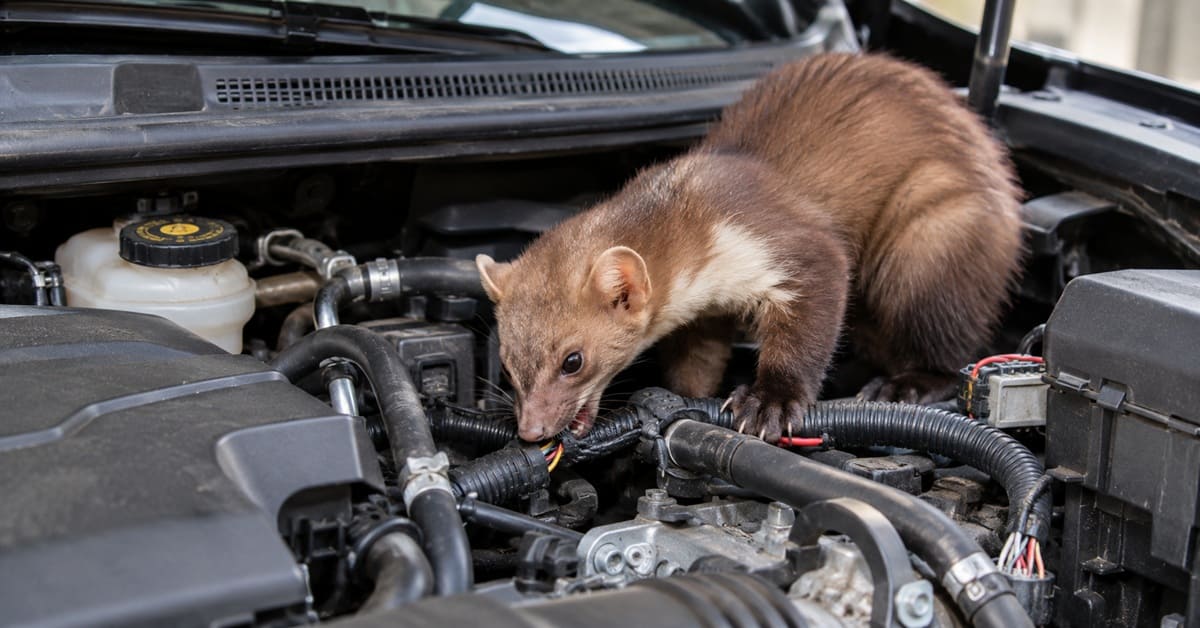
6 home remedies against stone martens: from dog hair to a water bottle

Paw prints on the windshield, rustling around the parked car, or perhaps torn insulation under the hood? Many car owners first try home remedies against martens. Dog hair, water bottles, air fresheners, or wire mesh placed under the car: those affected share plenty of ideas with one another on local and international car forums.
We have collected six methods that rely on tools that are easy to obtain here as well. Their success is not guaranteed; the reports reflect personal experiences, but it is worth learning what idea lies behind each method.
1. Dog hair or cat hair against martens
Perhaps this is the best-known home remedy: owners place dog or cat hair collected during grooming into a small, breathable bag and put it near the car. The idea is that the smell of another animal may make the marten cautious, prompting it to choose a different route or hiding place.
This solution also comes up in car discussions across Europe. Some commenters report a longer calm period after placing it out. One variation of the method is a cloth that has absorbed the smell of the dog’s bedding: here too, the same basic idea applies, with the scent indicating an animal’s presence being the key.
If you try it, it is worth placing the hair in a way that it does not scatter, get blown away by the wind, or stay continuously soaked. Do not place loose hair, a cloth, or a bag near the engine’s hot or moving parts. Check and refresh the package placed around the car from time to time.
2. Water-filled bottles around the car
You have surely seen a parked car with plastic bottles filled with water lined up beside its wheels. Bottle-based marten deterrence is also a practice known across Europe, and several explanations are associated with it.
According to one idea, the light glinting off the water and plastic, along with the unusual reflections, may confuse the animal. Another explanation ties the supposed effect to changes in temperature: the small popping or cracking sounds produced as the bottle and the air inside it warm up and then cool down may make the marten cautious. This should be treated as a possible explanation, not a proven mechanism.
Its appeal lies in its simplicity: a few sealed PET bottles and water are enough. The bottles are usually placed next to the wheels or along the car’s approach path. Make sure they cannot roll onto the roadway, do not obstruct pedestrians, and pick them up before driving off.
3. Toilet air freshener near the car
At first, it sounds unusual, yet the use of toilet air freshener is a recurring idea on Hungarian and German car forums as well. The basis of the method is its strong, unfamiliar scent: users hope that the intense smell makes the usual spot less attractive to the marten. Several people report favorable experiences with it.
It is important to distinguish between presenting a forum idea and using the product as intended. Toilet air freshener was not designed for under-hood conditions, so do not hang it on a hot part, pipe, or cable, and do not let its contents get onto the car’s surfaces.
With scent-based methods, placement is not the only factor; the weather and how long the smell lasts also matter. If someone tries such a solution, it is worth checking regularly what is happening around the car and whether the placed item is still in proper condition.
4. Lavender scent sachet
Lavender is a well-known household fragrance, and it also appears on car forums as an idea against martens. For example, one German car owner reported using lavender placed at the front and rear of the car. The idea here is also that the unusual, intense scent may influence where the animal chooses to stay.
Dried lavender can be kept together in a breathable fabric sachet. In a covered carport or garage, it is easier to find a spot for it where it will not get wet and will not be blown away by the wind.
It is worth observing whether the traces around the car change after placement. Regular checks help you determine whether you are seeing a favorable change at your own parking spot, and when it makes sense to supplement the protection with another solution.
5. Peppermint oil: mainly among methods against mice
On English-language car forums, cotton wool scented with peppermint oil or small scent sachets often come up. This is mentioned primarily as a way to keep mice away, so it is worth treating it separately from experiences specifically related to martens.
The difference is important because the marten is not a rodent, but a predator from the weasel family. However, the tracks around the car do not always make it clear at first which animal has been there. For help with identification, see our article Rodent or marten in the car’s engine bay: signs, damage, and protection.
The peppermint idea is based on a strong scent. Do not spray essential oil directly onto cables, plastic parts, or the car’s paintwork, and do not stuff oil-soaked cotton between engine-bay components. You should also follow the product’s usage instructions and consider access by pets.
6. Wire-mesh frame under the parked car
A wire-mesh frame placed under the car, along the line of the engine bay, is a solution known in German car communities. This differs from the previous methods: it does not try to work through smell or sound, but instead changes the surface the marten travels across.
According to the idea, the mesh may create an uncertain, unfamiliar feeling under the animal’s paws, so it is more likely to avoid it. Several people on forums recommend it, and it also appears in German municipal information materials as a possible supplementary solution, without any guaranteed result.
This is most manageable on your own, fixed parking spot. The frame should not have protruding wire ends that could cause injury, it should not catch on the car, and it should not end up in pedestrians’ way. The goal is not to trap or injure the animal, but to make approaching it less appealing.
Observe what works for you
Whichever home remedy you choose, it is worth checking and photographing the area around the car, as well as the visible parts of the cold engine bay, beforehand. That way, it is easier later to spot new traces, carried-in materials, or changes in the insulation.
A paw print on the hood and damage in the engine bay are two different things. Do not just watch for whether something climbed onto the car, but also whether anything has changed under the hood. If you find a damaged wire or hose, have it checked by a professional before driving.
Keeping the parking area tidy is also a useful part of prevention. In addition to removing accessible pet food, waste, and clutter that can provide hiding places, it is also worth checking the entry points to the garage. And if you are not using the car for weeks, make sure in advance that it will be checked periodically.
If you would also like automatic protection alongside home remedies
In addition to home methods, you can also choose a solution that we designed specifically for deterring animals in the car’s engine bay. Vadalarm AutoGuard uses variable-frequency ultrasonic sound and flashing white light to make staying in the engine bay uncomfortable for animals that venture inside.
One of its advantages is that it can be used without connecting to the car’s electrical system. Charge it via USB-C, mount it securely in the right place, then switch it on. In standalone mode, it deters with ultrasonic sound and light signals every 5 seconds, and on a single charge it can operate for up to 3 months under favorable conditions.
It is also practical if the car battery is hard to access, or if you simply do not want to deal with electrical wiring.
Three operating modes, tailored to use
To the best of our knowledge, there is not yet another car marten deterrent on the European market that changes its behavior depending on whether it is connected to the car battery or used independently. AutoGuard also assigns a separate operating mode for USB-C external power supply.
- Standalone use: powered by its own battery, it deters with ultrasonic sound and light signals every 5 seconds. A single charge can provide up to 3 months of operation.
- Car turbo mode: when connected to the 12 V car battery, it charges its own battery while the vehicle’s charging system is running. 3 minutes after charging from the vehicle stops, an extra-strong alert starts.
- Mains turbo mode: when powered from a USB-C mains supply, it emits ultrasound for 1 second every 3 seconds while the white LED flashes rapidly. Its power consumption is less than 0.5 W.
In car turbo mode, it does not drain the car battery while parked: it runs the alert from its own built-in battery, for up to a month in this mode. When the vehicle’s charging system starts working again, the alert stops, and AutoGuard resumes charging itself. You do not need to switch it on and off manually every time you start or stop the car.
In a garage, a separate unit can also operate from a mains power supply, complementing the AutoGuard installed in the engine bay. Proper placement is important in both cases: leave open space in front of the speaker and LED, and follow the instructions in the user manual.
Learn about the Vadalarm AutoGuard car marten and rodent deterrent, and choose the operating mode that fits your driving habits!
Frequently asked questions
Do home remedies keep martens away for sure?
Their success is not guaranteed. The experiences shared on forums vary, so it is worth watching for changes at your own parking spot and checking the engine bay regularly.
Why do people place water bottles next to the car’s wheels?
They are used as a home remedy against martens. Some explain the supposed effect by reflections of light, others by the popping sounds that occur as temperatures change. These are not proven mechanisms of action, but rather ideas associated with the method.
Could a cloth smelling of dog scent be used instead of dog hair?
This variation also appears on forums, based on the same scent-based idea. When placing it, make sure the fabric cannot get near hot or moving parts.
Do the same remedies work against martens and mice?
This cannot be assumed automatically. The marten is a predator, while the mouse is a rodent, and their behavior is different. It is worth identifying the visitor first, and treating experiences related to each animal separately.
Can I use AutoGuard alongside home remedies too?
Yes, but the placed items should not cover the device’s speaker or LED, and should not interfere with safe operation. Proper mounting of AutoGuard and periodic inspection of the engine bay remain important.
Can AutoGuard be used even if I do not want to connect it to the car battery?
Yes. It can also run from its own battery and be charged via USB-C, so you can use it without any electrical wiring. In this case too, it must be mounted securely in the engine bay in the location specified in the user manual.
Was this article helpful?